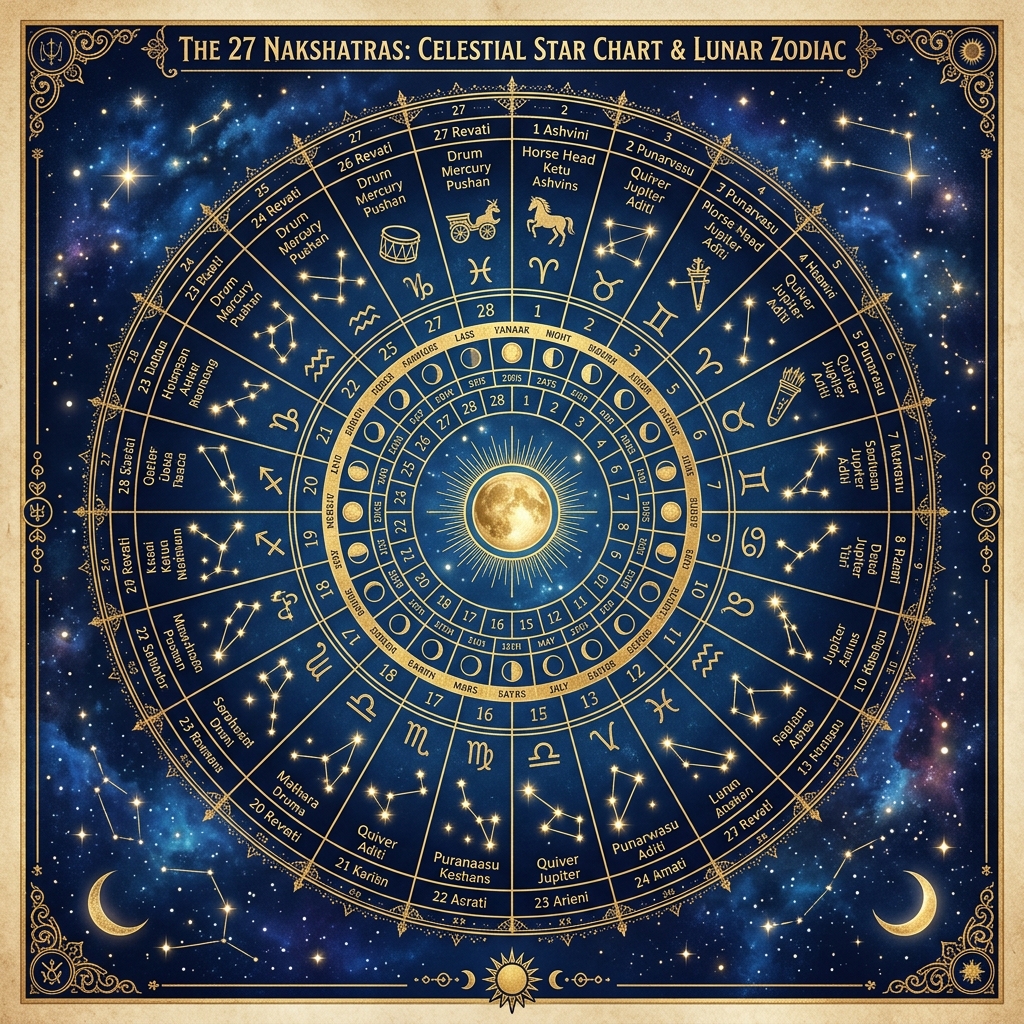
All 27 Nakshatras Explained: Meanings, Symbols, and Personality Traits
The 27 Nakshatras are the real building blocks of Vedic astrology — more precise than your sun sign, more revealing than your moon sign alone. Here is the complete guide to every nakshatra and what it says about you.
If you've only ever looked at your Vedic sun sign or moon sign, you're missing the most precise layer of your chart. The Nakshatras — the 27 lunar mansions of Vedic astrology — divide the zodiac into segments of 13°20' each, giving the system a resolution that sun-sign astrology simply cannot match. Your Moon nakshatra in particular is considered by many Vedic astrologers to be the single most important point in your birth chart. Here is the complete guide to all 27.
What Are Nakshatras?
The word nakshatra comes from Sanskrit: naksha (map) + tra (guard). These are the 27 star clusters the Moon passes through during its roughly 27.3-day orbit around Earth. Each nakshatra has a ruling deity, a ruling planet, a symbol, a guna (quality), and a set of personality characteristics. Your Moon nakshatra — the constellation the Moon occupied at your birth — reveals your emotional instincts, subconscious patterns, and the texture of your inner life more accurately than your sun sign does.
Find your Moon nakshatra instantly with your free Vedic birth chart.
The 27 Nakshatras — Complete Reference
1. Ashwini (0°–13°20' Aries)
Symbol: Horse's head | Ruling planet: Ketu | Deity: Ashwini Kumars (divine physicians)
Ashwini is the nakshatra of beginnings, healing, and speed. People born with their Moon here are often quick-thinking, adventurous, and naturally drawn to healing or medicine. There's an almost childlike eagerness to Ashwini — a desire to start things, to move fast, to arrive first. The shadow side is impatience and a difficulty finishing what was so enthusiastically started.
2. Bharani (13°20'–26°40' Aries)
Symbol: Yoni (womb) | Ruling planet: Venus | Deity: Yama (god of death and dharma)
Bharani carries themes of creation, destruction, and transformation. It is ruled by Venus but governed by Yama — an unusual pairing that gives Bharani natives both sensual intensity and a deep relationship with endings. These people often live large, feel deeply, and carry significant karmic responsibility. They are capable of great creative output and equally intense self-destruction when out of balance.
3. Krittika (26°40' Aries–10° Taurus)
Symbol: Razor or flame | Ruling planet: Sun | Deity: Agni (fire god)
Krittika is the nakshatra of purification, discipline, and sharp discernment. Ruled by the Sun with Agni as deity, this is a nakshatra of tremendous willpower and the capacity to cut away what is false. Krittika Moon people often have strong opinions, high standards, and a critical intellect. The razor symbolism is apt — they can wound with words as easily as they illuminate.
4. Rohini (10°–23°20' Taurus)
Symbol: Chariot or ox cart | Ruling planet: Moon | Deity: Brahma (creator)
Rohini is considered one of the most auspicious nakshatras. The Moon is in its own nakshatra here — deeply at home. Rohini people are often beautiful, creative, sensuous, and naturally magnetic. They love beauty in all forms — art, music, fine food, fine things. Lord Krishna is said to have been born in Rohini. The shadow: possessiveness, attachment, and difficulty letting go.
5. Mrigashira (23°20' Taurus–6°40' Gemini)
Symbol: Deer's head | Ruling planet: Mars | Deity: Soma (moon god)
Mrigashira is the eternal seeker. Like a deer endlessly searching for nectar, people born here are curious, restless, and always pursuing something just out of reach. They are gentle, sensitive, and often highly creative. The searching quality can be a gift (relentless curiosity) or a wound (never quite arriving).
6. Ardra (6°40'–20° Gemini)
Symbol: Teardrop or diamond | Ruling planet: Rahu | Deity: Rudra (storm god)
Ardra is the nakshatra of storms, both literal and metaphorical. Ruled by Rahu with Rudra as deity, this is intense, transformative energy. Ardra Moon people often go through dramatic life upheavals that are ultimately purifying — like a monsoon clearing stale heat. They can be intellectually brilliant, emotionally volatile, and capable of tremendous empathy precisely because they've known suffering.
7. Punarvasu (20° Gemini–3°20' Cancer)
Symbol: Bow and quiver | Ruling planet: Jupiter | Deity: Aditi (mother of the gods)
Punarvasu means "return of the light." Jupiter-ruled with Aditi as deity, this nakshatra carries themes of renewal, optimism, and homecoming. People born here often have a remarkable resilience — they get knocked down, they recover, they return. There's a natural positivity and philosophical outlook that makes them excellent teachers, advisors, and healers.
8. Pushya (3°20'–16°40' Cancer)
Symbol: Flower, circle, arrow | Ruling planet: Saturn | Deity: Brihaspati (Jupiter, preceptor of the gods)
Pushya is considered the most auspicious nakshatra for auspicious beginnings — weddings, business launches, spiritual initiations are traditionally begun under Pushya. Saturn-ruled with the divine teacher as deity, this nakshatra produces people with genuine wisdom, patience, and a nurturing spirit. They often become the pillars of their community — deeply trusted, quietly powerful.
9. Ashlesha (16°40'–30° Cancer)
Symbol: Coiled serpent | Ruling planet: Mercury | Deity: Nagas (serpent deities)
Ashlesha is the nakshatra of the serpent — penetrating, hypnotic, and wise. Mercury-ruled with serpent deities, this is a nakshatra of deep psychological perception. Ashlesha people can see through facades with uncanny accuracy. They are often strategic, introverted, and intensely private. The shadow side — and it is real — is manipulation, clinging, and the capacity to poison what they cannot control.
10. Magha (0°–13°20' Leo)
Symbol: Royal throne | Ruling planet: Ketu | Deity: Pitrs (ancestral spirits)
Magha is the nakshatra of royalty, ancestry, and honor. Ketu-ruled with ancestral deities, this nakshatra carries a strong sense of lineage and pride in heritage. Magha people often feel — correctly — that they carry the weight of their ancestors. They are natural leaders with a regal bearing, and they do not accept disrespect easily. The work is to honor tradition without being imprisoned by it.
11. Purva Phalguni (13°20'–26°40' Leo)
Symbol: Front legs of a bed | Ruling planet: Venus | Deity: Bhaga (god of pleasure and prosperity)
Purva Phalguni is the nakshatra of pleasure, creativity, and passionate love. Venus-ruled with the deity of delight, these are the natural hedonists of the zodiac — but hedonism in the best sense: full presence, sensory enjoyment, artistic expression. They are generous, radiant, and deeply romantic. The shadow is laziness and attachment to luxury.
12. Uttara Phalguni (26°40' Leo–10° Virgo)
Symbol: Back legs of a bed | Ruling planet: Sun | Deity: Aryaman (god of contracts and unions)
Where Purva Phalguni is the honeymoon, Uttara Phalguni is the marriage — the committed, long-term partnership. Sun-ruled with Aryaman as deity, this nakshatra produces people who are reliable, service-oriented, and driven by a genuine desire to support others. They often have exceptional organizational ability and social grace.
13. Hasta (10°–23°20' Virgo)
Symbol: Open hand | Ruling planet: Moon | Deity: Savitar (sun deity of skill)
Hasta means "hand" — and these people are gifted with their hands in every sense: craftsmanship, healing touch, sleight of hand, and the ability to manifest tangible results. Moon-ruled, they are emotionally adaptable and often have a quick wit. They are excellent problem-solvers who prefer practical solutions over theoretical ones.
14. Chitra (23°20' Virgo–6°40' Libra)
Symbol: Bright jewel | Ruling planet: Mars | Deity: Vishwakarma (divine architect)
Chitra is the nakshatra of artistry, beauty, and architectural genius. Mars-ruled with the divine craftsman as deity, Chitra people are visionaries who must create. They are often exceptionally beautiful or possessed of an aesthetic eye that borders on supernatural. Fashion, design, architecture, filmmaking — these are Chitra domains. The shadow is vanity and the compulsion to be admired.
15. Swati (6°40'–20° Libra)
Symbol: Sword or fresh shoot of grass | Ruling planet: Rahu | Deity: Vayu (wind god)
Swati is the nakshatra of independence and flexibility. Like the shoot of grass that bends in the wind without breaking, Swati people are resilient, adaptable, and fiercely committed to their freedom. Rahu-ruled with the wind god, there is a restless, seeking quality here — these people thrive in business, trade, and any field that rewards social intelligence and flexibility.
16. Vishakha (20° Libra–3°20' Scorpio)
Symbol: Triumphal arch | Ruling planet: Jupiter | Deity: Indra and Agni
Vishakha is the nakshatra of purpose and determined achievement. Jupiter-ruled with the king of the gods as co-deity, these people are intensely focused on their goals and don't stop until they achieve them. They can be single-minded to the point of ruthlessness. The arch symbol is perfect — Vishakha people are always passing through a threshold toward the next achievement.
17. Anuradha (3°20'–16°40' Scorpio)
Symbol: Lotus | Ruling planet: Saturn | Deity: Mitra (god of friendship)
Anuradha is the nakshatra of devotion, friendship, and the ability to bloom in darkness — like the lotus growing from mud. Saturn-ruled with Mitra as deity, these people form intensely loyal bonds and are capable of profound spiritual dedication. They often travel far from home and build deep connections wherever they land. They are the ones people call at 3am.
18. Jyeshtha (16°40'–30° Scorpio)
Symbol: Circular amulet | Ruling planet: Mercury | Deity: Indra (king of gods)
Jyeshtha means "eldest" or "most senior" — and these people carry the weight of that designation. Mercury-ruled with Indra as deity, they are natural leaders with strategic minds and considerable personal power. They often carry heavy responsibilities from a young age. The shadow: a tendency to overreach, to accumulate power beyond what serves them, and a deep fear of being dethroned.
19. Mula (0°–13°20' Sagittarius)
Symbol: Tied roots | Ruling planet: Ketu | Deity: Nirriti (goddess of destruction)
Mula means "root" — and this is the nakshatra of going to the very bottom of things. Ketu-ruled with a goddess of dissolution, Mula people are compulsive investigators of truth. They are not satisfied with surface answers. They often experience significant upheaval that strips away false foundations — painful in the moment, clarifying in retrospect. Great researchers, investigators, and spiritual seekers are born here.
20. Purva Ashadha (13°20'–26°40' Sagittarius)
Symbol: Elephant tusk or fan | Ruling planet: Venus | Deity: Apas (water goddess)
Purva Ashadha is the nakshatra of invincibility and purification. Venus-ruled with the water goddess, there is a cleansing, renewing quality here. These people often have enormous confidence — sometimes before they've earned it — and a remarkable ability to convince others of their vision. They are persuasive, idealistic, and deeply committed to their causes.
21. Uttara Ashadha (26°40' Sagittarius–10° Capricorn)
Symbol: Elephant tusk | Ruling planet: Sun | Deity: Vishwadevas (universal gods)
Uttara Ashadha is the nakshatra of lasting victory — not quick wins, but achievements that endure. Sun-ruled with universal deities, these people are focused on legacy and long-term impact. They are disciplined, principled, and willing to take the slow path if it leads somewhere real. The Sun gives them an inner light that others find reassuring.
22. Shravana (10°–23°20' Capricorn)
Symbol: Ear or three footprints | Ruling planet: Moon | Deity: Vishnu (preserver)
Shravana means "listening" — and these are the great listeners and learners of the zodiac. Moon-ruled with Vishnu as deity, Shravana people have exceptional memories and a reverence for knowledge. They are often deeply connected to their cultural and spiritual traditions. There is a quality of preservation here — these are the ones who remember what others forget and pass it on.
23. Dhanishtha (23°20' Capricorn–6°40' Aquarius)
Symbol: Drum | Ruling planet: Mars | Deity: Eight Vasus (elemental gods)
Dhanishtha means "most famous" or "swiftest." Mars-ruled with elemental gods as deities, these people are rhythmically gifted — music, dance, and any art with a pulse comes naturally. They are ambitious, high-achieving, and genuinely talented. The shadow is a difficulty with emotional intimacy — the drum is outward-facing, and Dhanishtha people can prioritize achievement over connection.
24. Shatabhisha (6°40'–20° Aquarius)
Symbol: Empty circle | Ruling planet: Rahu | Deity: Varuna (god of cosmic order)
Shatabhisha means "100 healers." Rahu-ruled with Varuna as deity, this is the nakshatra of the mystic healer — someone who works with invisible forces to bring things back into order. These people are often drawn to medicine, astrology, and any field that investigates hidden patterns. They are private, self-sufficient, and sometimes intensely solitary. They see what others miss.
25. Purva Bhadrapada (20° Aquarius–3°20' Pisces)
Symbol: Front legs of a funeral cot | Ruling planet: Jupiter | Deity: Ajaikapad (one-footed serpent god)
Purva Bhadrapada is a nakshatra of intense spiritual energy, sometimes bordering on the extreme. Jupiter-ruled with a fierce serpent deity, these people are capable of profound spiritual insight and equally capable of obsession. They can channel anger into passion and passion into transformation. When evolved, they are powerful teachers and healers. When unevolved, they can be erratic and self-destructive.
26. Uttara Bhadrapada (3°20'–16°40' Pisces)
Symbol: Back legs of a funeral cot | Ruling planet: Saturn | Deity: Ahirbudhnya (serpent of the deep)
Uttara Bhadrapada is one of the deepest nakshatras — a place of profound wisdom, self-sacrifice, and connection to hidden realms. Saturn-ruled with a deity of the cosmic deep, these people are old souls with genuine spiritual depth. They are patient, compassionate, and often serve in ways that go unrecognized. They work quietly, and their contributions are rarely obvious until they're absent.
27. Revati (16°40'–30° Pisces)
Symbol: Fish or drum | Ruling planet: Mercury | Deity: Pushan (god of safe journeys)
Revati is the final nakshatra — the last station before the cycle begins again with Ashwini. Mercury-ruled with the divine shepherd as deity, Revati people are gentle, nurturing, and often deeply spiritual. They carry a quality of completion — a sense that they have been here before and are closing something out. They are compassionate guides who make others feel safe on difficult journeys. Revati is the destination and the beginning simultaneously.
How to Use Your Nakshatra
The most important nakshatra in your chart is your Moon nakshatra — it reveals your emotional nature, your instinctive reactions, and the quality of your inner life. Your Ascendant nakshatra shapes how you present yourself to the world. Your Sun nakshatra illuminates your core purpose.
In the Vimshottari Dasha system — Vedic astrology's primary timing method — every planetary period is determined by which nakshatra your Moon occupies at birth. This means your nakshatra isn't just a personality description; it's the foundation of your entire life timing system. Find your nakshatra and your complete Dasha timeline in your free Vedic chart.
Free · No Signup
Read your own chart — not just articles about charts.
Generate your Vedic or Western birth chart with AI analysis in 30 seconds.