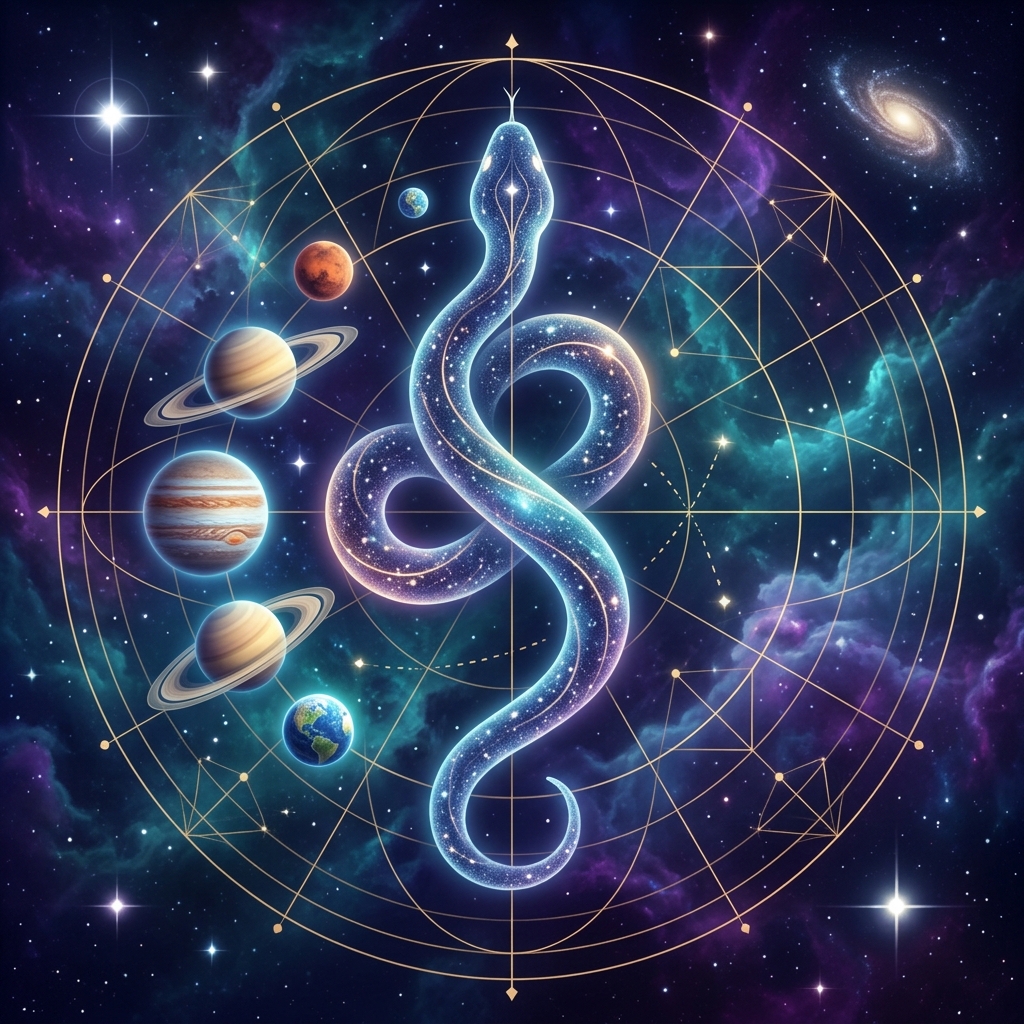
Kaal Sarp Dosha is one of the most feared — and most oversold — combinations in Vedic astrology. Here's what it really is, the 12 types, when it gets cancelled, and how to tell genuine guidance from a pandit selling an expensive puja.
Almost everyone who hears the words "Kaal Sarp Dosha" hears them the same way: from an astrologer, in a slightly lowered voice, usually followed by a recommendation for a puja that costs more than a month's rent. The family tenses. Someone books a trip to Trimbakeshwar. And the person whose chart it supposedly is walks away convinced their life is under a curse they didn't ask for.
Here's the part nobody leads with: Kaal Sarp Dosha is real as a chart pattern, frequently misdiagnosed, often cancelled, and almost never the catastrophe it's sold as. Let's go through it honestly.
What Kaal Sarp Dosha Actually Is
The definition is precise and worth getting right, because most of the fear comes from people who never learned it. Rahu and Ketu — the Moon's north and south nodes — always sit exactly opposite each other, 180 degrees apart. They divide your chart into two halves. Kaal Sarp Dosha forms when all seven visible planets — Sun, Moon, Mars, Mercury, Jupiter, Venus, and Saturn — fall on one side of that Rahu-Ketu axis.
That's it. The name means "serpent of time" — Rahu is the serpent's head, Ketu its tail, and the imagery is of all your planetary energy "swallowed" between them. It's evocative. It's also just a description of where the planets sit, not a verdict on your life.
The condition is binary. If even one planet sits outside the Rahu-Ketu arc, the dosha does not exist — full stop. This single rule cancels a huge number of the "diagnoses" people walk around carrying.
The Detail That Cancels Most Diagnoses
Free online calculators are where most false alarms start. Nearly all of them check only the sign a planet sits in, not its exact degree. That's a meaningful error.
Picture Rahu at 15° Aquarius and Mercury at 22° Aquarius. Same sign — so a sign-based calculator says "hemmed in, dosha present." But Mercury has actually crossed past Rahu's degree, which breaks the hemming. A degree-based reading says no dosha. The cheap calculator got it wrong, and someone just got scared for no reason.
If you've been told you have Kaal Sarp Dosha by an app, treat it as a maybe, not a fact. Generate a proper chart with exact planetary degrees — our free Kundali generator gives you the degree of every planet so you can check the Rahu-Ketu axis honestly — and verify the hemming at the degree level before you believe anything that follows from it.
The 12 Types — and Why the Type Matters More Than the Label
Kaal Sarp Dosha isn't one thing. It takes 12 forms, each named after a mythological serpent and defined by which house Rahu occupies (Ketu is always six houses away). The type tells you which area of life gets the concentrated nodal pressure — and that's far more useful than the scary umbrella term.
- Anant (Rahu 1st, Ketu 7th) — self vs. partnership; identity and marriage themes.
- Kulik (Rahu 2nd, Ketu 8th) — wealth, family, speech; sudden financial shifts.
- Vasuki (Rahu 3rd, Ketu 9th) — courage, siblings, fortune, higher learning.
- Shankhpal (Rahu 4th, Ketu 10th) — home, property, and professional standing.
- Padma (Rahu 5th, Ketu 11th) — children, education, creativity, gains.
- Mahapadma (Rahu 6th, Ketu 12th) — health, debts, enemies, foreign matters.
- Takshak (Rahu 7th, Ketu 1st) — marriage and business partnerships.
- Karkotak (Rahu 8th, Ketu 2nd) — sudden events, transformation, inheritance.
- Shankhchoor (Rahu 9th, Ketu 3rd) — father, luck, beliefs, long journeys.
- Patak / Ghatak (Rahu 10th, Ketu 4th) — career stability and reputation.
- Vishdhar (Rahu 11th, Ketu 5th) — income, desires, and matters of children.
- Sheshnag (Rahu 12th, Ketu 6th) — expenses, sleep, hidden enemies, and isolation.
Notice what this list does: it turns a vague curse into a specific, readable map. "You have Sheshnag" means "watch spending and rest," not "your life is doomed." The house axis is the actual information.
The Honest Bit: It's Not in the Classical Texts
This is the part most astrologers skip, and it's important. Kaal Sarp Dosha is not described in the foundational Vedic texts — there's no chapter on it in the Brihat Parashara Hora Shastra. It appears in later medieval and folk traditions. That doesn't make it meaningless; plenty of experienced astrologers report observing consistent patterns — recurring delays, a feeling of effort not converting to results, lives that swing between extremes rather than sitting comfortably in the middle. But it does mean the doom-laden certainty around it is a modern invention, not ancient scripture.
It's also more common than the fear implies — roughly 5–8% of charts show a genuine, degree-verified version. And the list of people who supposedly have it and did just fine is long enough to be its own argument: many widely cited business and sports figures are said to carry this exact pattern. A configuration that "ruins lives" doesn't keep showing up in the charts of people who built empires.
When It Gets Diluted or Cancelled
Even when the hemming is genuine, the chart usually has counterweights. Kaal Sarp Dosha is rarely the only thing happening in a horoscope, and several common conditions soften or neutralise it:
- A strong benefic. A well-placed Jupiter or Venus — especially one aspecting Rahu or Ketu — can dilute the intensity dramatically.
- Strong Raja Yogas. An exalted or powerfully placed 9th or 10th lord can override the pattern's drag entirely.
- Dignified planets. Planets in their own or exalted signs don't behave like trapped energy, regardless of where the nodes sit.
- Saturn's or Jupiter's aspect. A well-disposed drishti onto the nodal axis frequently dilutes much of the supposed effect.
The deeper point: the nodes describe a pattern, but timing comes from your Dasha. Even a genuine Kaal Sarp Dosha mainly expresses itself during Rahu or Ketu Mahadasha and Antardasha periods — not evenly across your whole life. If you're not in a nodal period, the practical weight of it is usually small. Knowing where you are in your Vimshottari Dasha tells you far more about your actual year than the label "Kaal Sarp" does.
About the Remedies
The standard prescription is the Kaal Sarp Dosh Nivaran Puja at places like Trimbakeshwar or Kalahasti, plus Rahu-Ketu beej mantras, Maha Mrityunjaya chanting, worshipping Shiva on Mondays, and charitable acts like feeding animals. If these are meaningful to you and bring peace of mind, there's genuine value in that — ritual and devotion do real psychological work.
But hold onto one rule: be deeply skeptical of anyone using fear to set a price. Genuine remedies in this tradition are simple, devotional, and accessible to everyone — mantras, charity, discipline, Shiva worship. The moment a "diagnosis" arrives bundled with an expensive, urgent, one-time-only ritual and a warning about what happens if you don't pay, you're looking at a sales pitch wearing the costume of astrology. The gemstone remedies (Hessonite for Rahu, Cat's Eye for Ketu) carry the same warning: never wear a nodal stone without a full chart reading, because the wrong stone amplifies a malefic rather than calming it.
What To Actually Do With This
If you've been told you have Kaal Sarp Dosha, work through it in order. First, verify the hemming at the degree level, not just by sign. Second, identify the type, so you know which house axis is actually involved. Third, check the counterweights — is there a strong Jupiter, a Raja Yoga, a dignified planet diluting it? Fourth, look at your Dasha, because that tells you whether the pattern is even active right now. Only after all four does any remedy conversation make sense.
Done in that order, "Kaal Sarp Dosha" stops being a curse and becomes what it always was: one pattern among many in a chart that deserves to be read as a whole. Generate your chart with our free Kundali tool, check the Rahu-Ketu axis with real degrees, and read the rest of the horoscope before you let two shadow planets write your story for you.
Free · No Signup
Read your own chart — not just articles about charts.
Generate your Vedic or Western birth chart with AI analysis in 30 seconds.