Saturn Return at 29: A Practical Survival Guide for What's Actually Happening
You're 27-30, and everything feels like it's falling apart or being forced to change. That's Saturn. Here's exactly what to expect at each stage — and how to come out the other side with your life actually yours.
You're somewhere between 27 and 30. The job that made sense two years ago suddenly doesn't. The relationship you thought was permanent is showing cracks — or already ended. The city, the friend group, the whole shape of your life is up for review in a way that feels both exhausting and somehow inevitable. You didn't ask for any of this. And yet here it is.
Welcome to your first Saturn Return. This is the definitive guide to what is actually happening to you — what triggers it, what it targets, what the stages look like, and what to do (and not do) to come out the other side with a life that's genuinely yours rather than the version you inherited or assembled by default.
What Triggers It: The Basic Mechanics
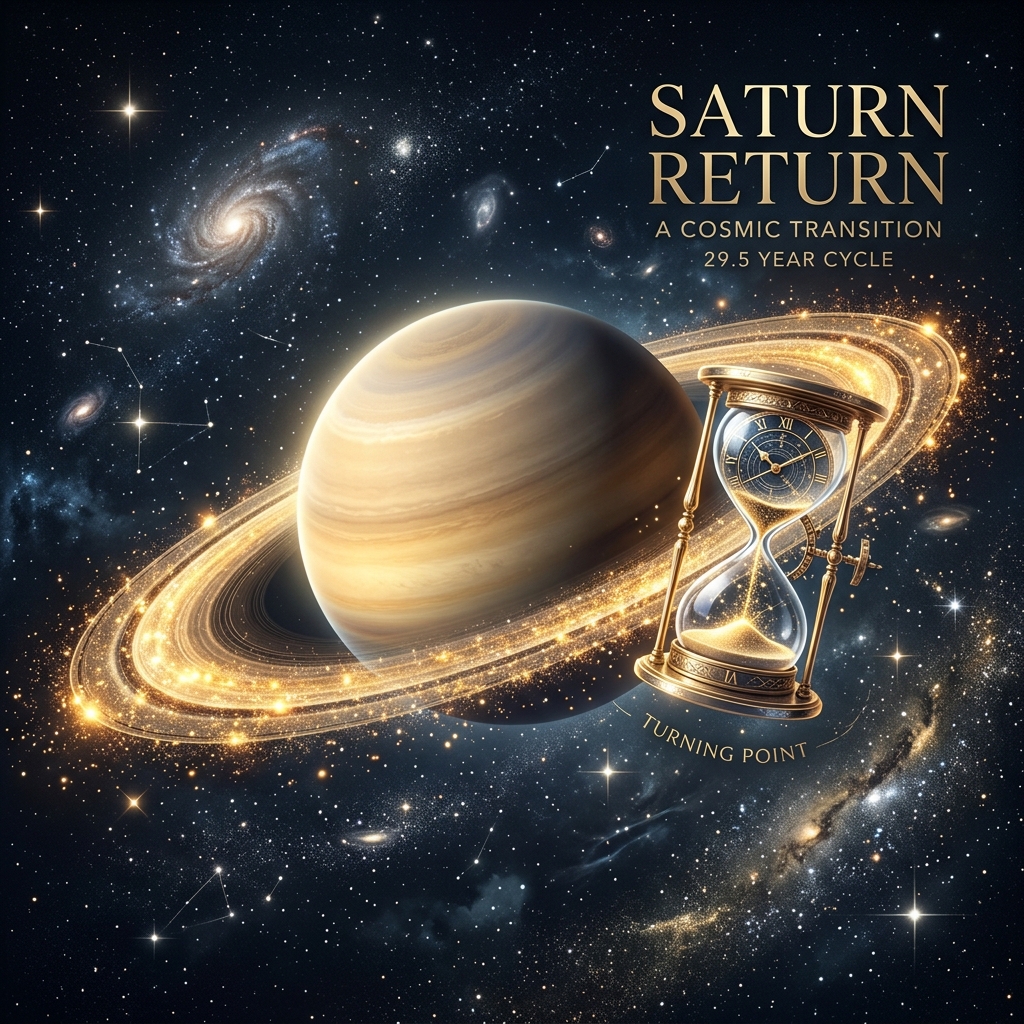
Saturn takes 29.5 years to complete one full orbit around the Sun. When it returns to the exact zodiac degree it occupied the moment you were born, that's your Saturn Return. The buildup typically starts around age 27. The peak is usually 29-30. The full transit — from when Saturn enters the same sign as your natal Saturn to when it exits — can last 2-3 years.
This isn't mythology. The 29.5-year cycle corresponds directly with developmental thresholds that psychology independently identifies: the transition from extended adolescence into genuine adulthood. The late-twenties restructuring is real. Astrology gave it a name and a mechanism centuries before developmental psychology did.
Check your Saturn placement to know exactly when your return peaks — it's different for everyone depending on your birth data.
The 6 Things Saturn Actually Comes For
Saturn doesn't touch everything equally. It goes after what isn't real. Specifically:
1. The career that was practical, not calling. The degree you chose because your parents expected it. The industry you fell into because it paid well. The role you accepted because it was available. Saturn asks: is this actually what you're here to do? If the answer is "I'm not sure," the return often forces the question by making the situation untenable.
2. The relationship built on convenience. The partnership that works because you're used to each other. The relationship maintained by inertia, shared housing, or fear of starting over. Saturn doesn't dissolve relationships that have genuine foundations. It tests them until the foundation either proves real or reveals that it was never there.
3. The identity borrowed from other people's expectations. The life you built to satisfy parents, peers, or cultural norms rather than your own actual nature. Saturn is ruthless here — it doesn't care that it took years to construct. If it wasn't built from the inside, the return dismantles it.
4. The avoidance patterns you've outgrown. The coping mechanisms that worked in your early twenties — overworking, overdrinking, perpetual distraction, the serial new-city new-job restart — stop working during the return. Saturn is signaling that the old escapes have expired.
5. The unrealistic self-image. Whether the illusion runs in the direction of false grandiosity ("I'll figure it out, I always do") or false smallness ("I can't, I'm not capable of that"), Saturn tends to correct it with reality.
6. Everything that was built to please others rather than to last. The theme underneath all of the above: Saturn distinguishes between structures you built to be approved of and structures you built because they're true. Only the latter survives.
The Stages — What It Actually Feels Like
Stage 1: The Pressure Builds (Ages 27-28)
Most people don't recognize this as the beginning of the return. It feels like restlessness, a low-grade dissatisfaction, the sense that something needs to change but you can't quite name what. The life that used to feel fine starts feeling tight. Relationships or career situations that were fine on the surface start surfacing friction that wasn't visible before. The impulse at this stage is usually to fix the symptoms — new job, new city, new relationship — without understanding the root cause is internal.
Stage 2: The Crisis Point (Ages 28-29.5)
This is the stage people mean when they say "my Saturn Return hit me hard." Whatever has been building comes to a head. Relationships end or demand a fundamental renegotiation. Careers collapse or become impossible to continue. Health issues emerge. Family patterns that were previously manageable become acute. The defining feature of this stage: the old solutions stop working. The things you used to do to feel okay don't work anymore. This is by design. Saturn is forcing a genuine overhaul, not a patch.
The mistake people make here is trying to outrun the process — quickly replacing what ended without doing the underlying work of understanding why it ended. Saturn will repeat the lesson until it lands.
Stage 3: The Integration (Ages 29.5-30 and beyond)
When the return is navigated honestly — meaning you've actually confronted what Saturn was surfacing rather than just rearranging deck chairs — this stage has a quality of arrival. Not arrival at comfort, exactly. Arrival at clarity. You know more specifically who you are, what you're actually here to do, what you actually want from partnership. The structures that survive the return are genuinely yours. The ones that fell apart... were supposed to.
What Your Saturn Sign Tells You About the Flavor
If you were born between 1988-1991, your Saturn is in Capricorn. Your return hits hardest in career and public identity — the pressure is to build something real, to be someone specific, to stop deferring ambition.
If you were born between 1991-1994, your Saturn is in Aquarius. Your return activates themes of community, belonging, and originality — the tension between fitting in and being genuinely yourself.
If you were born between 1994-1996, your Saturn is in Pisces. Your return dissolves structures built on illusion, escapism, or spiritual bypassing — the pressure is toward grounded, concrete reality.
If you were born between 1996-1999, your Saturn is in Aries. Your return comes for false starts, reckless self-assertion, and the parts of your identity built on reaction rather than genuine self-knowledge.
If you were born between 2000-2003, your Saturn is in Gemini or Cancer. The return themes involve communication, learning, and foundational security — building an emotional home base that's truly yours.
The House Your Saturn Occupies: Where the Pressure Lands
The zodiac sign tells you the flavor. The house tells you the department of life where Saturn applies pressure:
Saturn in the 1st: Identity, appearance, self-expression — who you are when you walk into a room.
Saturn in the 2nd: Money, values, self-worth — financial structures and what you actually value.
Saturn in the 4th: Home, family of origin, roots — often involves literal moves or family reckoning.
Saturn in the 7th: Partnership and marriage — the most relationship-focused return.
Saturn in the 10th: Career, public reputation, ambition — professional restructuring.
Saturn in the 12th: Hidden fears, spiritual life, institutions — inner work, shadow confrontation.
What To Do — And What To Avoid
Do: Stop Treating This as a Problem to Solve
Saturn Returns are not crises to manage — they are reorganizations to participate in honestly. The people who struggle most are those who spend enormous energy trying to restore what Saturn is trying to end. The people who come through most cleanly are those who ask "what is this trying to show me?" rather than "how do I make this stop?"
Do: Get Precise About What's Actually Yours
This is the core work of the return: distinguishing between the life you built from your own genuine values and nature versus the life you constructed to be acceptable, safe, or approved of. The question to ask about every major structure — career, relationship, location, friend group, self-concept — is: Does this exist because it's true for me, or because I thought it should be?
Do: Let Things End Cleanly
One of the most valuable things you can do during a Saturn Return is let what wants to end actually end — without prolonging it through guilt, fear, or nostalgia. Dragging out relationships that have concluded, staying in careers that have clearly run their course, maintaining a life shape that no longer fits — all of this extends the disruption rather than resolving it.
Avoid: Making Major New Commitments Mid-Crisis
The peak of the return (that Stage 2 window) is a poor time to make major new commitments — new marriages, new long-term contracts, large financial decisions — unless you've done the work to understand what you're actually building. Decisions made in the panic of Stage 2 often need to be undone later. Let the dust settle first.
Avoid: Interpreting the Disruption as Failure
The relationship that ends during your Saturn Return was not a failure. The career that falls apart was not evidence that you can't succeed. Saturn Returns can look from the outside — and feel from the inside — like a disaster while they're happening. What they are: an accelerated edit. The version of your life that exists on the other side is more real, more sustainable, and more genuinely yours than the one you were living before. That's not failure. That's the whole point.
After the Return: What Changes
People who have navigated their Saturn Return describe the same shift, in different words: you stop needing external permission to be who you are. The approval of parents, peers, and cultural expectation loses its grip — not through rebellion, but through genuine self-knowledge. You know who you are now in a way you simply couldn't at 22.
Your 30s, navigated from that foundation, are different from your 20s. You make fewer decisions based on what looks good and more based on what's actually true. You waste less time on relationships that don't fit and career paths that don't call. The work of the return is hard. The life on the other side of it is worth every bit of it.
See your Saturn placement, exact return dates, and full natal chart analysis free at AstroAsk.
Free · No Signup
Read your own chart — not just articles about charts.
Generate your Vedic or Western birth chart with AI analysis in 30 seconds.