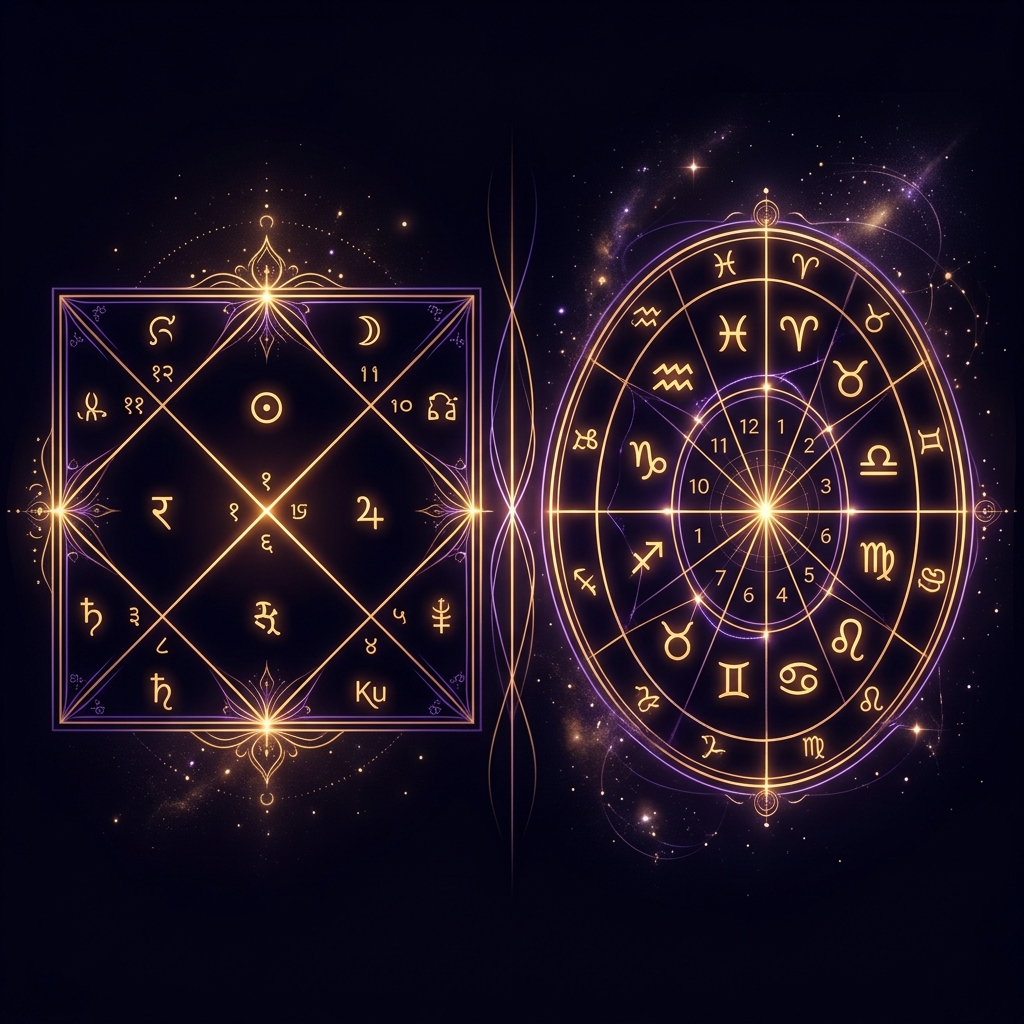
Why does your sign change between the two systems? Which one is more accurate? And the real question: what is each one actually good at? An honest breakdown — without the tribalism.
Finding out your sign changes when you switch from Western to Vedic astrology is jarring the first time. If you've identified as a Scorpio your whole life and suddenly you're a Libra, it feels like the ground moved. Which one is right?
Both — but they're answering different questions. The two systems aren't competitors measuring the same thing with different tools. They're genuinely different frameworks built for different purposes. Once you understand what each one is actually designed to do, the "which is better" debate stops making sense.
Why Your Sign Changes: The Technical Reason
Western astrology uses the tropical zodiac, tied to Earth's seasons. Zero degrees Aries always falls on the Spring Equinox — the moment the Sun crosses the celestial equator heading north, around March 20-21 each year. The zodiac is anchored to the seasons, not the stars.
Vedic astrology uses the sidereal zodiac, anchored to actual fixed star positions in the sky. The standard reference used in India — the Lahiri Ayanamsa, officially adopted by the Indian government's Calendar Reform Committee in 1955 — defines the zodiac starting point based on the star Spica's position.
Earth's axis wobbles in a slow 26,000-year cycle. Because of this, the tropical and sidereal zodiacs have drifted about 23-24 degrees apart since the common era. That's roughly one full zodiac sign — which is why your Sun sign typically shifts back by one when you switch from Western to Vedic. If you've always been told you're an Aries, in Jyotish you're almost certainly a Pisces.
What Each System Is Actually Built For
Western astrology — especially in its modern form shaped by 20th-century depth psychology — is primarily a self-understanding system. It excels at personality mapping, psychological archetypes, and relationship dynamics. It centers the Sun: who are you, at your core, and how do your patterns play out in the world? The Sun sign isn't just a label in Western astrology — it's considered the organizing center of the chart.
Vedic astrology (Jyotisha) is primarily a timing and predictive system. It centers the Ascendant (Lagna) and Moon rather than the Sun. Its most powerful tool — the Vimshottari Dasha — maps your life into planetary periods, each with predictable themes and events, enabling specific predictions about when things will happen rather than just what kind of person you are. "You're likely to have a career shift in the next two years" is a Vedic astrology answer. "You have a strong drive for independence balanced against a need for security" is a Western astrology answer. Both are valid. They're just different questions.
Three Things Vedic Has That Western Doesn't
The Dasha system is the most significant. The Vimshottari Dasha assigns each of the nine planets a fixed ruling period and maps your life through them in a specific sequence determined by your Moon's Nakshatra at birth. This timing tool enables event-specific predictions — career changes, marriages, health challenges — with a precision that Western transits and progressions approach differently.
The Nakshatra system adds a layer of precision to personality and timing analysis that Western astrology has no direct equivalent for. The 27 lunar mansions, each spanning just 13°20', produce genuinely different personality profiles for people who share the same Moon sign but sit in different Nakshatras. They also drive the Dasha timing framework entirely.
Varga (divisional) charts give Vedic analysis depth that a single birth chart can't provide. The D9 (Navamsa) illuminates marriage and dharma. The D10 (Dasamsa) reveals career. These are charts within your chart — layers of analysis available to Jyotish practitioners that Western astrology approaches through different techniques.
What Western Does Better
Western astrology's integration of Jungian psychology has produced an extraordinarily refined language for self-understanding. If you want to understand your unconscious patterns, your family of origin dynamics, or the psychological roots of recurring relationship problems — Western astrology has decades of sophisticated vocabulary for this that Vedic astrology approaches more indirectly.
Western aspect work — precise angular relationships between planets at specific degrees — also creates a detailed web of psychological nuance. Vedic aspects are house-based rather than degree-based, which is structurally different and produces different kinds of interpretations.
The Practical Answer
Use both for different questions. Use Vedic when you want to know what chapter of life you're in, what the next few years are likely to bring, and what planetary period is currently shaping events. Use Western when you want to understand your psychological patterns, your relationship dynamics, and the deeper motivations behind your choices. Generate your Vedic Kundali and your Western birth chart — reading both together gives you the most complete picture either system can offer.
More Articles

How to Find Your Rising Sign (And Why It Changes Everything About Your Chart)
7 min read
Your Moon Sign Meaning: What All 12 Signs Reveal About Your Emotional Nature
10 min read
Sun, Moon, Rising: What Your 'Big 3' Actually Tells You
8 min read
Free · No Signup
Read your own chart — not just articles about charts.
Generate your Vedic or Western birth chart with AI analysis in 30 seconds.