
Is Vedic compatibility still relevant today? We explore the 36 Gunas of Ashtakoot Milan and how this ancient system translates to modern relationship dynamics. Try our free compatibility calculator.
The conversation in the astrologer's office usually goes one way. Two charts go in. A number comes out — twenty-two out of thirty-six, twenty-eight out of thirty-six. The family nods. Something in the room either relaxes or tightens depending on that number.
Most people in that room, including the couple, have no real idea what the number is counting. They know it's "good" or "needs remedies," but not why, or which of the eight categories matters most, or whether a score of 24 with Nadi Dosha is actually worse than a score of 20 without it. (It is.)
This is an attempt to actually explain the system.
Why It's Built Around the Moon
The Ashtakoot system calculates everything from a single starting point: the Moon's Nakshatra (lunar mansion) in each person's birth chart. Not the Sun sign. Not the Ascendant. The Moon's exact Nakshatra.
This isn't arbitrary. The Moon in Vedic astrology governs your mind, your emotional instincts, your behavioral rhythms — the version of you that a spouse actually lives with, not the version you present at work or at a first meeting. When you're tired, anxious, or in conflict, it's your Moon that's running the show. A compatibility system designed for long marriages very reasonably focuses on what the Moon reveals.
What the Eight Categories Actually Measure
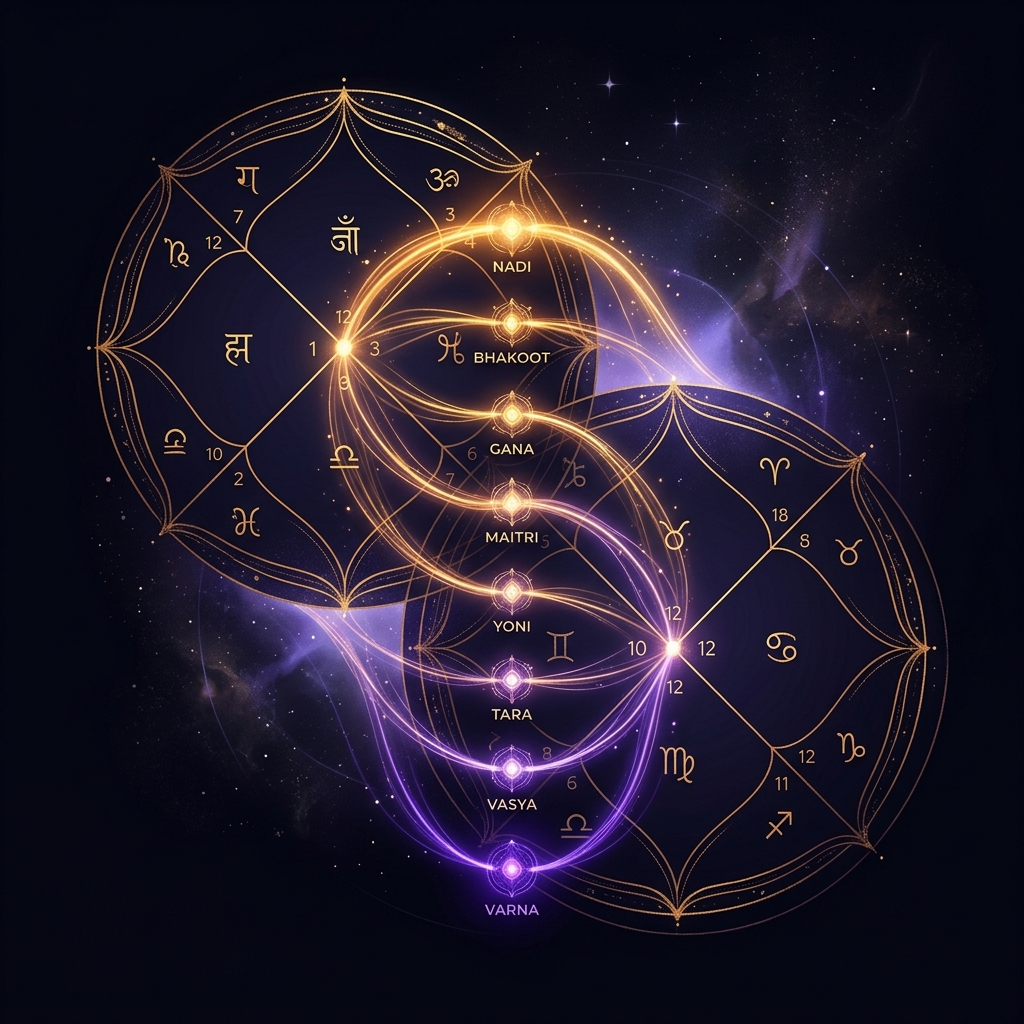
Varna (1 point) is about spiritual and ego alignment — whether both people are operating from a similar level of personal development. The low weight reflects reality: this is the compatibility dimension most responsive to growth, conversation, and time.
Vashya (2 points) measures the gravitational pull between two people — who naturally influences whom, and whether that dynamic feels like respect or friction. Healthy Vashya looks like mutual interest. Unhealthy Vashya looks like one person consistently steering the other without genuine reciprocity.
Tara (3 points) checks auspiciousness — whether being with this person is energetically good for you or quietly draining. Based on the relative position of birth stars, it asks a question that sounds mystical but maps to something real: do you feel better or worse after time with this person?
Yoni (4 points) covers physical and instinctive chemistry. Each Nakshatra is symbolized by a specific animal, and those animal pairings have classical compatibility ratings. Yoni predicts the instinctive behavioral rhythms two people settle into when they're close — and whether those rhythms feel natural or continuously awkward.
Grah Maitri (5 points) is the planetary friendship between each person's Moon sign lords. If your Moon is in a sign ruled by Venus and theirs is ruled by Mercury, and Venus-Mercury are classical friends, this scores high. What it's predicting is simple: whether you naturally enjoy talking to each other. Most long marriages run on this.
Gana (6 points) is temperament compatibility. Nakshatras are classified as Deva (gentle, principled), Manushya (balanced, practical), or Rakshasa (intense, driven). Same-Gana pairs are easiest. The Deva-Rakshasa combination scores zero — not because it can never work, but because the friction is structural and requires continuous effort to navigate rather than something that resolves with familiarity.
Bhakoot (7 points) examines the relative position of the two Moon signs. Certain configurations — the 6-8, 9-5, and 12-2 moon sign relationships — are associated with financial strain and reduced domestic harmony. It carries high weight because its effects tend to be material and relational, which are harder to overcome through personal development alone.
Nadi (8 points) is the most weighted category and the most feared. Each Nakshatra belongs to one of three Nadis — Adi, Madhya, or Antya. Matching Nadi between partners creates Nadi Dosha, associated with health complications and challenges around children. That said, classical texts describe specific cancellation conditions: if both partners share the same Nakshatra, or both are in the same Rashi, the Dosha is considered cancelled. Most charts flagged for Nadi Dosha have at least one of these conditions. Check before drawing conclusions.
Reading the Score Correctly
Below 18 indicates significant incompatibility across multiple dimensions. 18-24 is workable — the range most real marriages fall into. 24-32 reflects natural alignment across most categories. Above 32 is rare, and some classical practitioners note that extremely high scores can indicate the charts are too similar, creating imbalance rather than complementarity.
The number alone is incomplete information. A score of 22 with uncancelled Nadi Dosha is a categorically different situation from a score of 22 where Nadi is cancelled. A score of 30 where Gana mismatches doesn't tell you the same story as a 30 where Gana scored full points. Always read the breakdown, not just the total.
The system also doesn't cover Mangal Dosha, the condition of each person's 7th house, Dasha compatibility, or Venus and Jupiter's strength in each chart — all of which can significantly override a Guna score in either direction. Our Kundali Matching tool covers the full analysis, not just the 36-point headline.
Free · No Signup
Read your own chart — not just articles about charts.
Generate your Vedic or Western birth chart with AI analysis in 30 seconds.