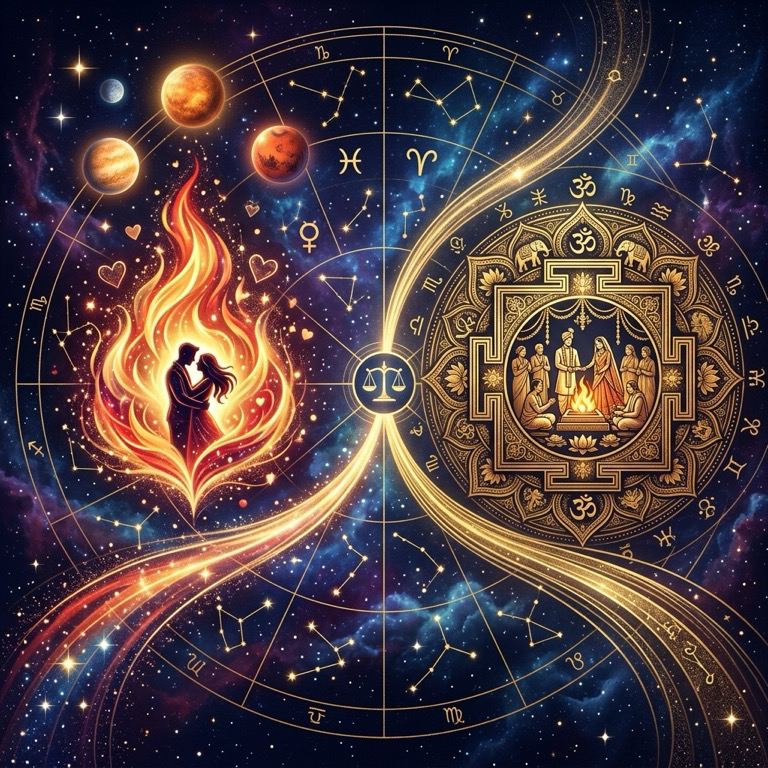
Love Marriage or Arranged Marriage? What Your Kundali Actually Shows
Your birth chart leans one way or the other — and Vedic astrology has specific signatures for each. Here's how the 5th, 7th and 9th houses, Venus, Mars and Rahu decide your path, plus what the research really says about which marriage lasts.
It's one of the first questions people bring to an astrologer, usually phrased nervously: "Will mine be love or arranged?" Sometimes it's hope. Sometimes it's a teenager who's already fallen for someone their family won't like, looking for permission from the stars. Either way, the chart does have an answer — or more honestly, a lean.
Vedic astrology doesn't predict love versus arranged like a coin flip. It reads which way your chart is wired: whether romance is built to lead you to marriage, or whether your marriage is more likely to arrive through family, structure, and introduction. Most charts aren't purely one or the other. But the signatures are real, and once you know them, your own chart becomes surprisingly readable.
The Two Houses Everything Hinges On
Marriage astrology runs on two houses. The 5th house is romance — attraction, courtship, the giddy first phase of falling for someone. The 7th house is marriage itself — the formal, committed, socially recognised partnership. The 5th is feeling; the 7th is structure.
The single most reliable rule in this entire subject is simple: when the 5th and 7th houses connect, romance converts into marriage — and that's love marriage. When they don't connect, marriage tends to arrive through other channels, which is the default signature for an arranged match.
"Connect" has specific meanings. The lord of your 5th house sitting in the 7th, the 7th lord sitting in the 5th, the two lords conjunct in the same sign, a mutual aspect between them, or a sign exchange (Parivartana Yoga) between the 5th and 7th lords — any of these wires romance directly into marriage. The exchange is the textbook love-marriage yoga.
The Planets That Tip the Scales
Beyond the houses, three planets do most of the talking:
- Venus is love itself — attraction, charm, romantic magnetism. A strong Venus (in its own signs Taurus or Libra, or exalted in Pisces) placed in or aspecting the 5th or 7th amplifies every love-marriage signal. Watch for Venus combust — within about 8° of the Sun — which is the most common quiet dampener, muddying romantic clarity even when other factors look promising.
- Mars is passion and pursuit. When Venus and Mars come together — conjunct, in mutual aspect, or in each other's signs — they form what the tradition calls Kamadeva Yoga, named for the god of love. People with this rarely settle for a partner chosen on paper; they're wired to choose for themselves.
- Rahu is the boundary-breaker. When Rahu touches the 5th or 7th house or their lords, marriage tends to defy convention — inter-caste, inter-religion, inter-nationality, or simply against family expectations. A Venus-Rahu conjunction in particular creates an almost compulsive pull toward an unconventional partner.
What an Arranged-Marriage Chart Looks Like
The arranged signature isn't an absence of anything — it's a different set of connections, centred on tradition and family rather than romance. Look for Jupiter aspecting the 7th house (the classic signal of an auspicious, elder-blessed union), the 9th lord connecting with the 7th (dharma and marriage aligned — the family's values shape the match), the 7th lord placed in family-oriented houses like the 2nd, 4th or 10th, and Saturn moderately influencing the 7th (a duty-oriented, stable, often later marriage). A "clean" 7th house — no Rahu, no afflicting Mars — with the 5th and 7th simply not talking to each other is the quiet default for marriage-through-introduction.
Most Charts Are a Blend
Here's the part the fear-and-certainty crowd skips. Modern charts — and modern marriages — are increasingly "love-cum-arranged": you choose, and the family blesses it. The astrology shows this clearly. A 5th-7th connection with Jupiter's aspect reads as a love match that families approve of. The 5th lord placed in the 9th house signals love that arrives through family-approved channels. A strong Venus alongside a Saturn influence on the 7th points to romance kept within traditional boundaries.
So don't read your chart as a binary verdict. Read it as a lean and a flavour. One strong love-marriage yoga makes that path more likely than average — it doesn't guarantee a runaway romance, and a clean traditional 7th doesn't doom you to marrying a stranger.
Timing: When the Path Activates
A signature in the chart is potential; your Dasha decides when it actually fires. Love connections tend to manifest during Venus Mahadasha or Antardasha, the 5th lord's period, or the 7th lord's period — and Rahu Dasha often brings the sudden, fated, cross-cultural kind. Transits matter too: Jupiter or Venus crossing your natal 5th or 7th can trigger a dormant indicator. This is exactly why two people with similar signatures marry a decade apart — their timing planets activate at different ages. Knowing where you are in your Vimshottari Dasha tells you far more about "when" than any generic age prediction.
And the Honest Question: Which One Actually Lasts?
People want astrology to settle this, but the better answer comes from research — and it's worth knowing before you stake your life on a stereotype. A 2024 cross-cultural study across five societies that practise both kinds of marriage found no significant overall difference in intimacy, passion, or commitment between love-based and arranged marriages. A long-running study of Indian couples in the U.S. found the same: both groups reported equally high satisfaction and love. The researchers' own conclusion was blunt — the Western assumption that arranged marriages lack love simply isn't supported by the data.
Arranged marriages do tend to show higher longevity statistics in India, but that reflects family structure and social support as much as the relationship itself — longevity isn't the same as happiness. The honest takeaway: neither path is astrologically or statistically "better." What your chart tells you is the route you're likely to take to partnership, not the quality of the marriage you'll have once you're in it. That part is built, not predicted.
How to Read Your Own Chart
Work through it in order. Is there a connection between your 5th and 7th lords? Is Rahu in or aspecting the 7th? Is Venus with or aspecting Mars? If yes to those, your chart leans love. Is Jupiter aspecting a clean 7th, with the 9th lord involved and no 5th-7th link? That leans arranged. Then check the Navamsa (D9) — the divisional chart that confirms marriage matters — and your Dasha for timing.
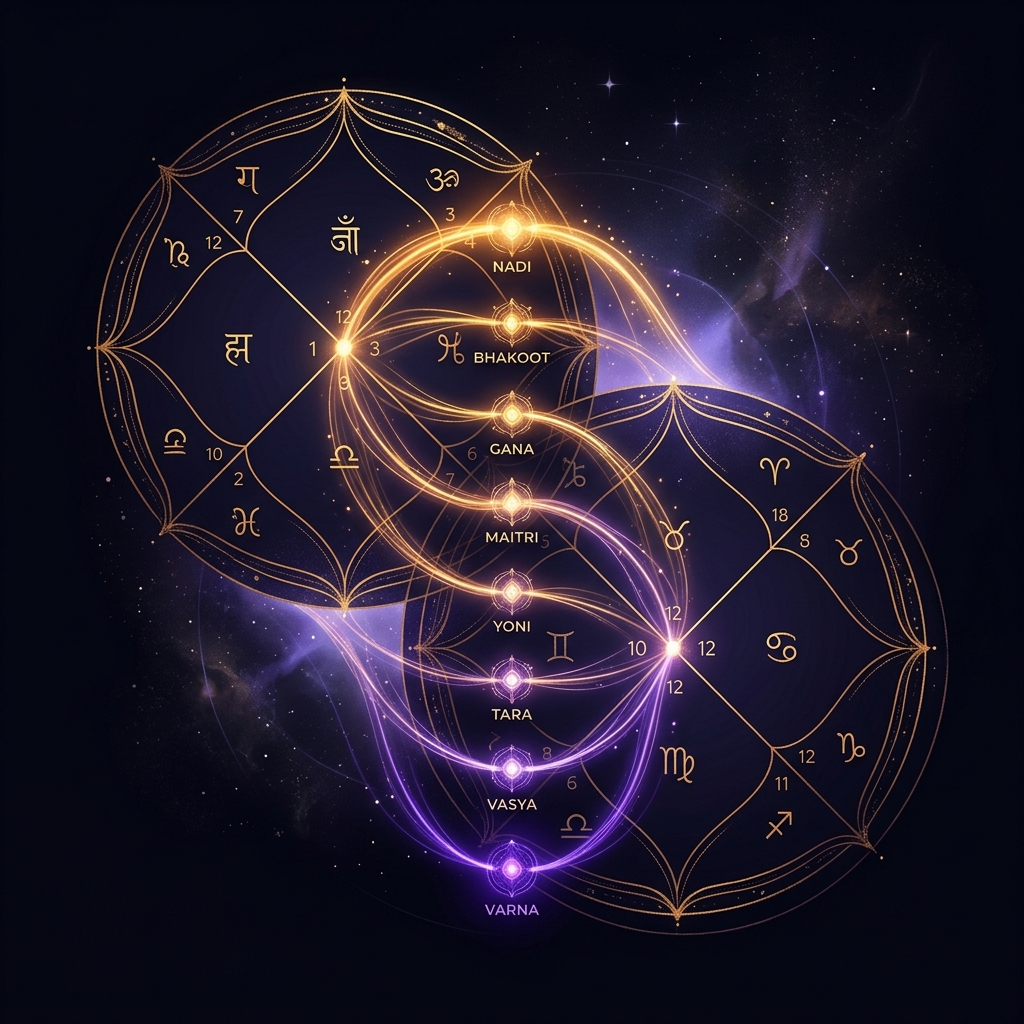
Generate your chart with our free Kundali tool to find your 5th and 7th lords and where Venus, Mars and Rahu actually sit. And whichever way your chart leans, if you have a specific person in mind, run both charts through our Kundali Matching tool — because the path to marriage matters far less than the compatibility of the two people walking it.
Free · No Signup
Read your own chart — not just articles about charts.
Generate your Vedic or Western birth chart with AI analysis in 30 seconds.