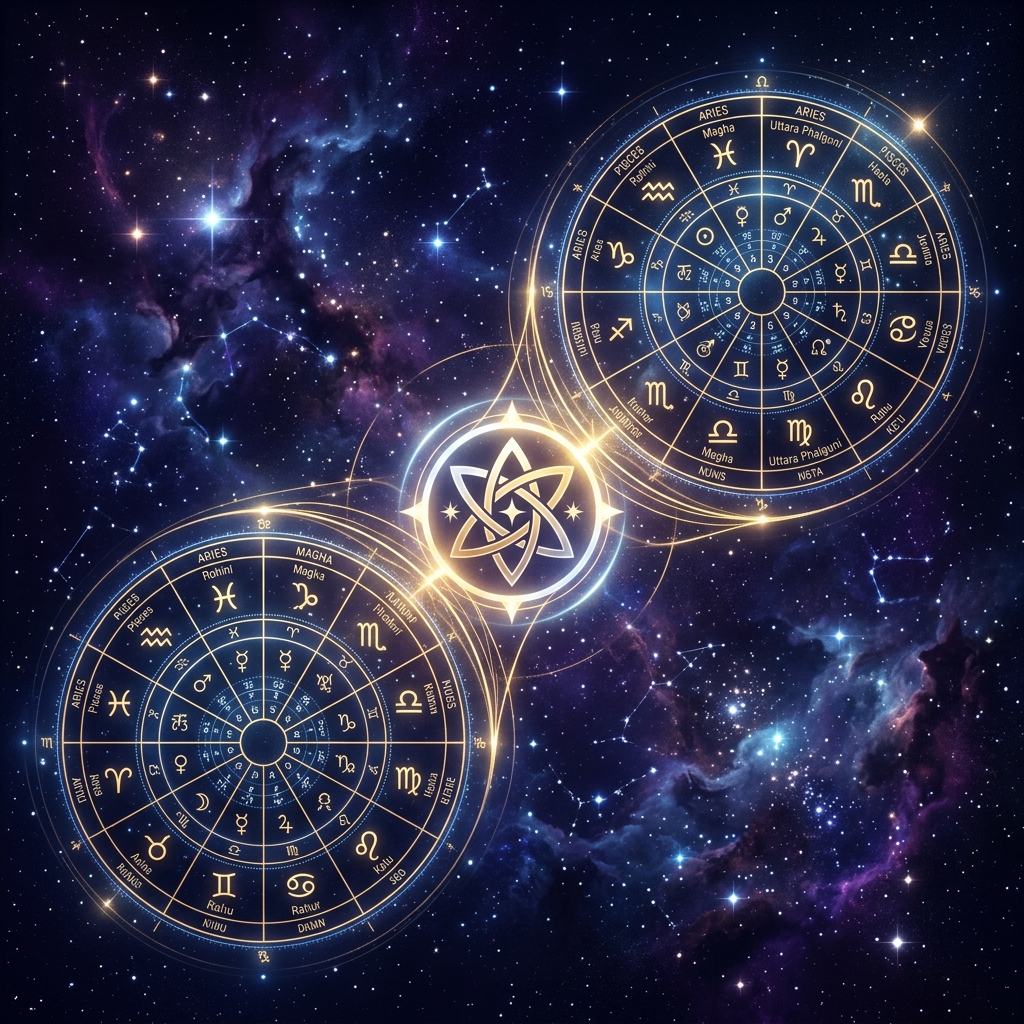
Marriage Timing in Vedic Astrology: How to Know When You'll Get Married
The most asked question in every astrology consultation — 'when will I get married?' — has a precise answer in Vedic astrology. It isn't guesswork. It's the intersection of your 7th house, Dasha sequence, and Jupiter's transit. Here's how it actually works.
Every astrologer hears it within the first five minutes. "When will I get married?" Not if. When. And honestly, that question deserves a real answer — not a vague "when the time is right" or a generic sun sign prediction that applies to half the planet. Vedic astrology actually has the tools to narrow it down. Not to a specific date, but often to a specific year. Sometimes even a season.
Here's the thing though — marriage timing in a kundali isn't one factor. It's three or four things landing in the same window. When they do, marriages happen even in the most unexpected circumstances. When they don't, even the most eligible, relationship-ready person stays single. Understanding this changes how you read your own chart completely.
Start with the 7th house — but don't stop there
Yes, the 7th house is where you look first. It's your marriage house, your partnership zone, the part of the chart that describes how you meet a life partner and what that relationship looks like. But the 7th house alone doesn't tell you when. It tells you what kind.
What actually matters is the lord of the 7th house — whichever planet rules the sign sitting on your 7th house cusp. Where that planet is placed in your chart, and how it's doing, shapes everything. If your 7th lord is sitting happily in the 11th house, you'll likely meet someone through friends or a social circle. In the 9th, there's often a foreign connection or someone from a very different background. In the 2nd, family plays a role. The 7th lord is essentially your marriage planet, and it tells a story.
Planets sitting inside the 7th house also matter, but in a different way. They color the marriage itself rather than the timing. Jupiter in the 7th? The partner tends to be wise, generous, maybe older. Venus there makes for a beautiful, sometimes idealized relationship. Mars in the 7th gets labeled Mangal Dosha and people panic — but it's not a curse. It just means the energy of partnership is intense, sometimes combustible, and needs a strong match. The timing question is still separate.
The real answer is in your Dasha
This is where Vedic astrology genuinely pulls ahead of everything else. The Vimshottari Dasha system — the planetary period system — is what actually answers "when." Your life is divided into major periods ruled by different planets, and marriage almost always happens when a Dasha connected to your 7th house activates.
The most straightforward one is Venus Dasha. Venus is 20 years long, and it governs love, beauty, and everything romantic. Doesn't matter what your ascendant is — when Venus Dasha runs, relationship matters come alive. Most people who get married during Venus Dasha describe the relationship as genuinely moving, not just practical. There's real feeling there.
Then there's the Dasha of your 7th lord. Whatever planet rules your 7th house, when that planet runs as a Mahadasha or even as an Antardasha inside someone else's Mahadasha — that's a window. So if you're an Aries ascendant, Venus rules your 7th, so again Venus is activated. Virgo ascendant? Jupiter rules Pisces in the 7th — so Jupiter periods are your marriage windows.
Jupiter's own Mahadasha is another one to watch, especially for women in the Vedic tradition where Jupiter (Guru) is considered the significator of the husband. But honestly even for men, Jupiter periods bring expansion and commitment. It's a 16-year period and it's responsible for a lot of marriages.
One thing people miss: the Antardasha matters as much as the Mahadasha. You might be in a Moon Mahadasha — not an obvious marriage period — but if Venus runs as your Antardasha within it, that window inside the window is when things happen. Astrologers always look at the combination, never just the major period alone.
Jupiter's transit is what pulls the trigger
Here's something that surprises people. You can be in a perfect marriage Dasha — Venus period, 7th lord activated — and still not get married that year. Because the Dasha creates the readiness, but a transit creates the event. And the transit that matters most for marriage is Jupiter's.
Jupiter moves through one zodiac sign per year. When it crosses your 7th house in the sky, that's the most direct marriage transit there is. The Dasha said "conditions are right," and Jupiter in the 7th says "this year." When both coincide, marriages happen fast — sometimes within months of that transit beginning.
Jupiter crossing your Lagna (1st house) also does it. And a more nuanced one: Jupiter transiting the house where your 7th lord is placed natally. If your 7th lord sits in the 11th, Jupiter moving through your 11th activates that planet — and through it, activates the marriage promise. This is why the same Dasha can produce marriage in one year but not another. It's which transit completes the circuit.
Saturn transiting the 7th does roughly the opposite. It slows things down, makes commitment feel heavy, sometimes removes relationships that weren't solid. If you're in a good Dasha but Saturn is sitting on your 7th right now, things might move more slowly than expected — but they typically complete once Saturn moves on.
Why your Navamsa chart is the final check
The Navamsa — the D9 chart — is what Jyotishis call the marriage chart. And experienced astrologers won't make any marriage prediction without looking at it alongside the birth chart.
The logic is simple. The birth chart (D1) shows the potential. The Navamsa shows whether that potential actually manifests. You can have a beautifully placed Venus in your D1 but if Venus is debilitated in the Navamsa, the promise is weakened. Relationships happen but they're harder. The commitment part is difficult. Conversely, a Venus that looks average in D1 but is exalted in Navamsa often produces a wonderful, lasting marriage — the outside packaging didn't promise it, but the inside structure delivers.
When a planet is Vargottama — meaning it sits in the same sign in both D1 and D9 — it becomes noticeably more powerful. If your 7th lord is Vargottama, that planet's Dasha is a very strong marriage window. It almost always delivers.
What's actually happening when marriage is delayed
Saturn connected to the 7th house is the most common reason marriages happen later than expected. Saturn aspecting the 7th, ruling the 7th, or sitting in the 7th all tend to push the timeline back. But here's the thing about Saturn delays — the marriages that eventually happen under Saturn influence tend to stick. They're not rushed, they're not glamorous in the early stages, but they're built on something real. Saturn-influenced marriages often only get better with time.
Rahu in the 7th creates a different kind of complication. Relationships start suddenly, sometimes with an unusual partner — different culture, different background, someone the family didn't expect. There might be one or two false starts before the lasting relationship forms. Rahu isn't patient and neither are the relationships it creates — but when it finally settles, it's usually because the person found something that genuinely fascinates them rather than just someone appropriate.
Ketu in the 7th is strange. There's sometimes an early relationship that ends in a way that never fully makes sense — it just dissolves. And then later, often during a spiritual or reflective period of life, a much more meaningful partnership forms. People with Ketu in the 7th often end up in relationships that feel karmic, like they've known the person before.
And if you're past the age when most people around you got married and you haven't — the most useful question isn't "what's wrong with my chart?" It's "which Dasha am I in right now, and have the marriage-activating Dashas already passed?" Someone who spent their entire Venus Dasha focused on career, or living somewhere they just weren't meeting people — they haven't missed anything. The Dasha window isn't closed forever. And the next favorable window in their chart will show up in the Antardasha sequence if not as a full Mahadasha.
One thing that changes everything: your exact birth time
All of this — the 7th house, the Dasha, the transits — depends on your Lagna being accurate. And your Lagna depends on your birth time. A 15-minute difference can shift your ascendant entirely, which changes your 7th house sign, which changes your 7th lord, which changes every single Dasha window we talked about above.
This is why people who check their horoscope by sun sign get such generic results. The sun stays in one sign for a month. The Lagna changes every two hours. The precision is in the Lagna and the Dasha. If you only have an approximate birth time, that uncertainty carries through every timing prediction — which is worth knowing upfront rather than treating a vague birth time as exact.
If you want to check where your 7th house actually sits, who your 7th lord is, and which Dasha and Antardasha you're currently running, generate your free Kundali on AstroAsk — it uses Swiss Ephemeris calculations so the planetary positions are accurate. And if you're thinking about compatibility with a specific person, Kundali matching will show you the full Ashtakoota analysis including the categories that matter most for long-term compatibility.
Free · No Signup
Read your own chart — not just articles about charts.
Generate your Vedic or Western birth chart with AI analysis in 30 seconds.