Rahu and Ketu: The Shadow Planets That Reveal Your Karmic Path
They're not planets — not even close. Yet Rahu and Ketu sit at the very heart of your Vedic birth chart, quietly mapping the entire karmic arc of your soul's journey across lifetimes.
They're not planets. Not even close. Astronomers won't find them through a telescope, and no spacecraft will ever photograph them. Rahu and Ketu are mathematical points — phantom intersections in the sky — and yet every serious Vedic astrologer will tell you they're the most consequential placements in your entire birth chart. More than your ascendant. More than your Moon sign. More, even, than your Sun. So what exactly are these "shadow planets," and why does every Jyotishi treat them like they hold the blueprint of your entire soul's journey?
The Astronomy: What Rahu and Ketu Actually Are
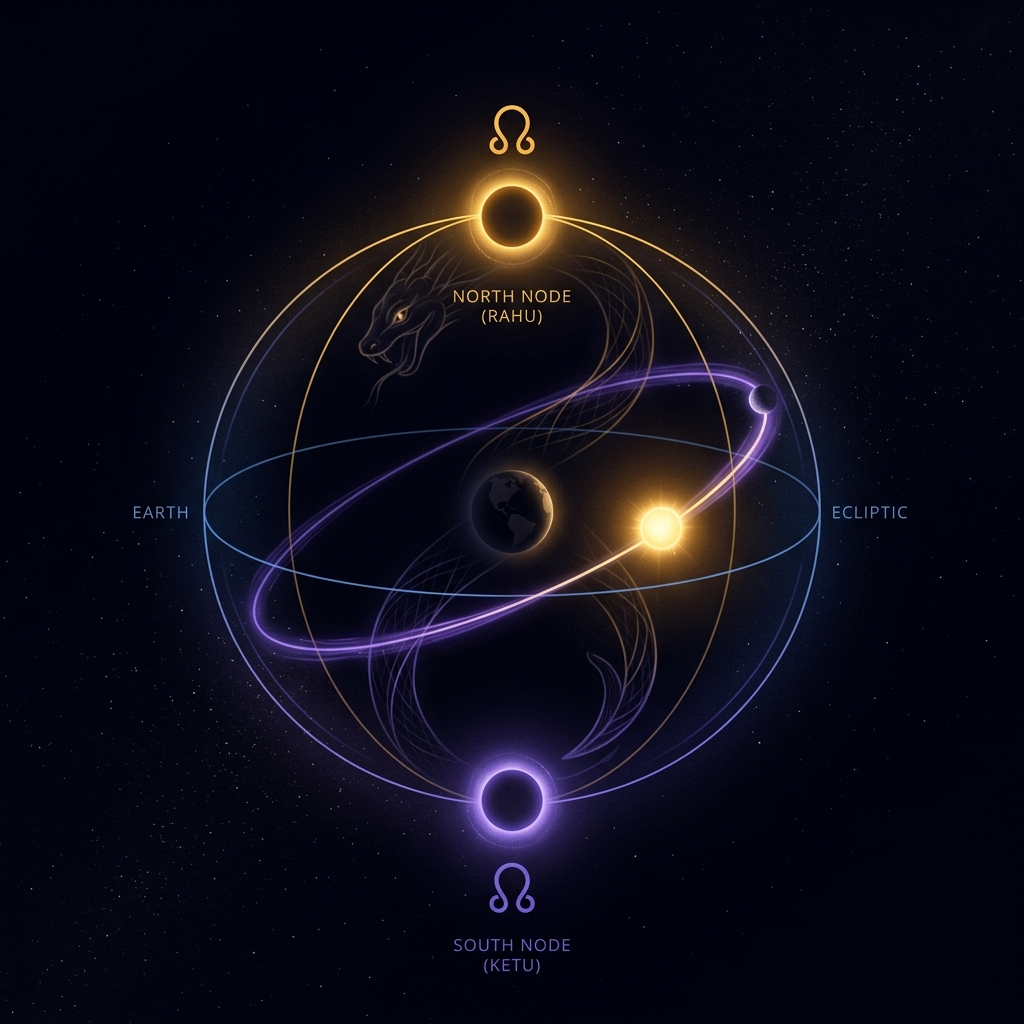
The Moon orbits the Earth on a slightly tilted plane relative to the Sun's apparent path across our sky (called the ecliptic). These two orbital paths cross at two points. The point where the Moon crosses upward through the ecliptic is the North Lunar Node. The point where it crosses back down is the South Lunar Node. In Vedic astrology, these are Rahu and Ketu respectively — the chhaya grahas, or shadow planets.
These crossing points are not objects. They cast no light. They have no mass. But they are the exact locations where solar and lunar eclipses happen. Rahu and Ketu are always exactly 180 degrees apart — always in opposite houses and opposite signs, always retrograde, sliding backward through the zodiac in a cycle of approximately 18.6 years.
The Myth That Explains Everything
During the churning of the cosmic ocean, a demon named Svarbhanu disguised himself as a god and slipped into the divine assembly to drink the nectar of immortality. The Sun and Moon spotted him. Vishnu immediately severed Svarbhanu with his Sudarshana Chakra — but too late. He had already swallowed the nectar. Both halves survived, immortal. The head became Rahu. The body became Ketu. Ever since, the head and body have been chasing the Sun and Moon across the sky — which is why eclipses happen.
This myth is a precise psychological description. Rahu is a head without a body: all hunger, all craving, all ambition — but no satisfaction, because there is no body to be fed. Ketu is a body without a head: fully capable of functioning, but disconnected from ordinary consciousness, detached from worldly desire, pointing somewhere beyond the material world entirely.
Rahu: The Hunger You Came Here to Chase
Rahu represents everything your soul is reaching toward in this lifetime. It is obsessive, amplifying, and insatiable by design. Wherever Rahu sits in your chart, you will feel a pull so strong it can feel like addiction — a compulsion to accumulate, achieve, experience, or consume in that area of life. And no matter how much you get there, it never quite feels like enough.
This is not a flaw. It is the mechanism. Rahu's hunger is what drives you out of old patterns and into new growth. It rules foreign lands, technology, unconventional paths, fame, and material ambition. The house Rahu occupies in your free Vedic Kundali is the arena where your soul has the least experience, the most to learn, and the most to gain.
Ketu: The Mastery You Need to Release
Ketu is the mirror image and counterbalance. Whatever house Ketu occupies represents skills so deeply ingrained in your soul's memory that they feel almost instinctive. You may be extraordinarily capable in that domain. You may also find, strangely, that you don't care.
That disinterest is not laziness. It is Ketu's signature: a kind of soul-level saturation. You've been there. You've mastered it. Now the cosmic curriculum is asking you to put it down and turn your energy toward Rahu's direction instead. Ketu governs spirituality, psychic sensitivity, liberation (moksha), past-life gifts, and sudden, inexplicable endings.
The Rahu-Ketu Axis by House
Rahu 1st / Ketu 7th: Called to develop strong individual identity; must release over-dependence on partnerships.
Rahu 4th / Ketu 10th: Here to find peace in home and inner life; must release compulsive drive for public status.
Rahu 7th / Ketu 1st: Called toward partnership and relationship; must release hyper-independence.
Rahu 10th / Ketu 4th: Here to pursue public achievement; must release the comfort of private, domestic life.
Rahu 5th / Ketu 11th: Called toward personal creativity and romance; must release tendency to dissolve into groups.
Rahu 9th / Ketu 3rd: Called toward higher philosophy and broad vision; must release the safe, local world of familiar communication.
To find where your own Rahu-Ketu axis falls, generate your free Vedic Kundali — it will show exactly which houses are activated.
Rahu Mahadasha: Eighteen Years of Intensity
In the Vimshottari Dasha system, Rahu's period lasts 18 years. For most people, it is the most turbulent, disorienting, and ultimately transformative stretch of their entire life. Ambitions accelerate. Foreign connections appear. Unconventional paths suddenly seem inevitable. Many people report feeling unrecognizable to themselves during this period — driven by desires they barely understand, chasing things they never expected to want.
What Rahu Mahadasha is actually doing is forcing the soul's hand. It compresses the karmic learning of an entire domain of life into eighteen years of lived experience. Those who lean into it — messy, confused, hungry and all — often emerge with a sense of self they couldn't have manufactured any other way.
For Western Astrology Readers
Rahu and Ketu are the exact same astronomical points as the North Node and South Node of the Moon — the calculation is mathematically identical. What differs is interpretation. Western astrology frames the North Node as soul destiny and the South Node as comfort zone. Vedic astrology goes considerably further: it assigns them full planetary status with their own Mahadasha periods and treats them as the spine around which the soul's entire karmic story is organized. Same astronomical axis. Considerably higher stakes interpretation.
More Articles
Vimshottari Dasha: The Ancient System That Explains Why Some Years Just Work
8 min read
How to Read Your Kundali for the First Time (And Actually Understand It)
9 min read
Marriage Timing in Vedic Astrology: How to Know When You'll Get Married
10 min read
Free · No Signup
Read your own chart — not just articles about charts.
Generate your Vedic or Western birth chart with AI analysis in 30 seconds.